Through out history, the role of women's fashion in our popular culture has been heterogeneous: there are different interpretations of how fashion has influenced women's roles in society, women's activism, and self-identity. According to one point of view, fashion has served as a function for social control. As feminist Susan Bordo claims, females have been portrayed as "docile bodies, whose forces and energies are habituated to external regulation, subjection, transformation, [and] 'improvement'" (Radner). Nevertheless, according to another point of view, women have "manipulated the codes of fashion in order to advance their interests… [and] resist social discipline" (Radner). In other words, fashion has served as a source for political and social progress, which greatly differs from the first approach. Lastly, yet in another standpoint, the importance of women's fashion is that it "acquires value within feminine culture as the cultivation of a feminine self" (Radner). Women create an identity, a relationship between the self to the self, based on body image and perceptions of aesthetics.
Thus, since fashion has shaped women's roles and portrayal in popular culture through a variety of ways, it is important to ask how fashion has changed over time and influenced women's sense of style since the early twentieth century. What can these changes say about women's progress? In particular, when, or in which time eras, can these three interpretations of fashion be seen, are the mutually exclusive or do they overlap each other? How are they significant?
Fashion Through the Roaring Twenties
For the purpose  of narrowing down the focus of this project, it begins analyzing women's fashion in 1920's, a decade that is commonly referred to as the "Roaring Twenties." This is a remarkable decade because for the first time, women’s fashion created controversy by embracing a modern era of fashion design. Much of this controversy is due to the growing relationship between fashion and identity (Van Cleave). It is precisely in this time era that the culture of mass consumption was born, where many early advertisers, magazines, and retailers “promoted the new idea that individuals could achieve self-fulfillment by constantly recreating themselves through consumption” (Van Cleave). Hence, this shift gave way to women’s exploration in fashion.
In addition, other social movements influenced this new outlook in fashion. During the World War I, women, specially the young and unmarried, took traditional men’s work in order to contribute to the war effort. When the war was over, these women had tasted independence—they “had gone to work [and] earned [their] money” (Hill 139). Furthermore, Margaret Sanger and Marie Stopes introduced birth control methods, freeing young women from the forced traditional child-bearing responsibilities (Hill 139). With all these social movements going on, a new young and modern woman was created—the flapper.
According to James Mulvagh, the new look for women was “the physique of a young boy; straight, hipless, bustless, waistless” (Hill 139). Thus, dresses were altered to fit this new demand. Hems were shorter, up to women’s knees, while “waistlines disappeared almost entirely” (“Fashion Forward”). In addition, the famous designer, Gabrielle “Coco” Chanel contributed to the change of women’s fashion by introducing the jersey and turning “sportswear into everyday clothes” (Hill 140). The introduction of simpler and more “provocative” dresses, which greatly differs from the traditional couture fashion prior to this decade, demonstrates how women sought a new identity. At one end, 1920’s popular fashions “were both representational of and necessary to women’s political, economic, and social progress” while at the same time, women sought the pursuit of personal pleasure such as sexual assertiveness.
The Great Depression’s Impact on Fashion
Despite these progressive movements seen in fashion during the 1920’s, the Great Depression called for “more conservative trends” (“Fashion Forward”). Typically, when there is chaos and uncertainty, society tends to have nostalgia for the past, for the security of the knowing. Thus, the Great Depression was no exception. Just as any other industry during this time period, the fashion industry faced economic hardship. Women began to “look back towards a more traditionally feminine look” (“Fashion Forwards”). The progressivism and search for a “modern” identity vanished as the waistline returned along with bust and hips, while dresses became longer.
World War II and the End of 4o’s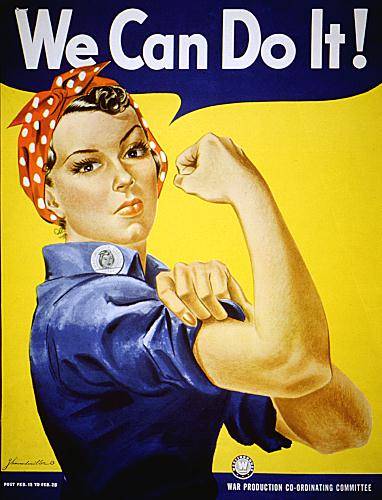
As the Great Depression ended and World War II began, fashion took a new direction once again. By 1942, the United States was deeply involved in the war effort, restricting garment silhouettes and fabric use, and prohibited ostentatious dressing (Hill 142). As a result of the severe material rationing, “fashions of the era emphasized shorter skirts than ever before and short, blocky jackets” while “millions of yards of fabric for the war effort” were saved (“Fashion Forward; Hill 142). Furthermore, just as in WWI but on a much grander cale, women entered into vacant traditional men’s jobs (since the men were fighting the war), adapting to more comfortable and safer clothing for work purposes. Women were encouraged to wear pants and slacks, promoting the ideal of a strong yet feminine patriotic American woman, as seen with "Rosie the Riveter" (Figure to the right). Although the fashion of WWII was socially controlled (regulating women by the limited variation of clothing), it also produced the opposite effect of liberating women from traditional clothing.
Nevertheless, once World War II was over, unlike post-WWI era, women had the longing for “elegance and luxury that had [long] been suppressed" during WWII (“Fashion Forward”). Unfashionable and minimalistic clothing was out, such as pants and slacks, as the “New Look” took ground. A prominent new fashion designer, Christian Dior, presented women with “longer skirts, detailed hats, gloves, high-heeled pumps, lots of jewelry, and an exaggerated silhouette created by the reemergence of the corset” (Hill 143). The hourglass figure was again emphasized, which represents fertility, through the widening of hips and narrow waist. Just as Jane Mulvagh claims, there “was a return to the traditional lifestyles of marriage and motherhood for many [working] women who…retired to their homes and contributed to the ‘Baby Boom’ of the late forties” (Hill 144). The progress of the young flapper during the 1920’s was officially long gone, while the new women sought to create a feminine and “stylish” identity.
The Conservative 1950’s
The “New Look” that ended in the 1940’s continued to influenced women’s fashion as the 1950’s began. Two of the most influential designers during this decade were Cristobal Balenciaga and Hubert de Givenchy who “enhanced the feminine form with clothing that echoed movement and gesture” (Hill 144). Women’s bodies were portrayed as docile, with sooth movements that emphasize the gentle roles women were supposed to take. Just as with many other mass consumption products, both, husbands and wives knew the “function of women’s clothes consumption,” which indicated more or less their social position (Barner & Lobel). In fact, according to a poll conducted by the Women’s Home Companion in 1947, a woman confessed the following: “My husband says I don’t spend enough and don’t represent him fairly” (Barner & Lobel). Traditional and conservative roles were thus emphasized, as women were expected to elevate their husbands’ reputation and making them proud by dressing fashionably. Hence, women's fashion was socially controlled, as the first function of fashion suggests, by external regulation and standard norms.

Perhaps the only innovative change during this decade was the mainstream adoption of the jeans by teenager boys and girls. Although this shift in fashion statement was only among young females and males, it was a movement away from traditional codes of fashion. In order to “defy tradition and separate themselves from their parents,” teenagers adopted the jeans, which set the stage “for the revolutions of the 1960’s (Hill 145-146).
1950's Women's Fashion: The Elegant, Fashionable, and Docile Woman
The Revolutionary 60's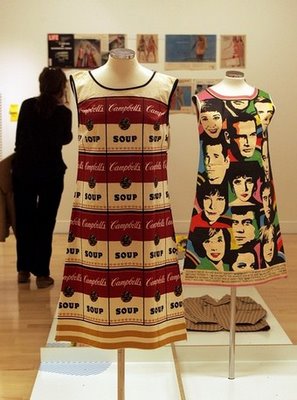
During the first half of the decade, not much change occurred in women’s fashion industry. The First Lady, Jackie Kennedy, who was very fashion forward, embraced traditional women’s role, influencing other women’s sense of fashion, but not changing fashion itself (Petrides; Hill 146).
Nevertheless, as the decade came to an ending, social movements (such as the Vietnam War, civil rights movements, and the counterculture revolution) influenced women’s fashion once more. In particular, the birth of the second wave of feminism (also referred to as the liberation movement) divided the American women in two groups, the radicals and the conservatives. While the conservatives preferred traditional roles and the already discussed sense of fashion, the radicals called for change. Betty Friedan’s book The Feminine Mystique created hype within popular culture as it discussed the “problems of women, and their unhappiness of being in the home” (Petrides). Furthermore, the banning of the sale of contraceptives and the legalization of abortion (Roe v. Wade) increasingly gave women liberation. Such social movements influence women's fashion, and could be seen with the introduction of variety of clothing, including the bell bottoms, the short miniskirt, and the hot pants (“Fashion Forward”). In fact, one of the most fashionable garments was the Andy Warhol inspired mini (shown in the figure to the right), which shocked the conservative world (Hill 148). Dresses had never been as short as the mini, which some women saw as progression to liberalization.
The Ambiguous 70’s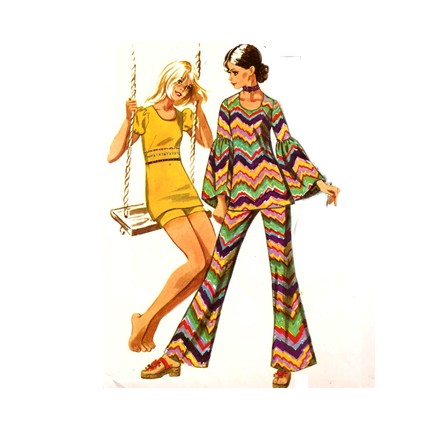
The anti-traditional and anti-fashion styles of the late 1960s “made their transition into the looks of the ‘uncertain seventies’” (Hill 149). During this decade, a new generation of designers, such as Calvin Klein and Bill Blass, “understood that the American women wanted easy, comfortable, coordinated clothing” (Hill 149). Since women had gained more independence throughout the 1960’s, by the following decade, they wanted a new identity that was reflected by comfortable clothing, fitting their “new” lifestyles. Although the 70’s fashion was characterized as “anything goes,” heavy fabrics were dropped while light materials where adopted (“Fashion Forward; Hill 149).
The 80’s Onward
As the 1980’s began, two trends became common in American fashion. At one end, “luxurious exhibitionism returned to fashion, [partly] inspired by the style-conscious First Lady” (Hill 152). Nancy Reagan generally preferred glamour and extravagance, with formal and decorated creations. At the other end, the simplistic approach that had begun in the 70's continued, creating ready-to-wear clothing. According to Daniel Hill, however, “the fashion industry had no political or social drama to generate any significant changes as the 1990’s dawned” (Hill 153). Instead, as Vogue claimed in the 1990's, “Fashion [had] long ceased to be one thing, one mood, one idea” (Hill 154). It had already become heterogeneous by then, as women had the ability to wear anything they pleased.
Conclusion
As seen throughout history, women’s fashion has been under constant influx, altering from time to time. Fashion has shaped women’s roles, just as women have influenced fashion. Furthermore, within each era’s, fashion has been under construction and served as three different functions—social control, social resistance, and search for identity (sometimes overlapping each other). In other words, women have looked towards fashion as a way to represent an identity, to seek for economic, political, and social progress, even though at times women’s liberation has been limited by fashion itself.
